
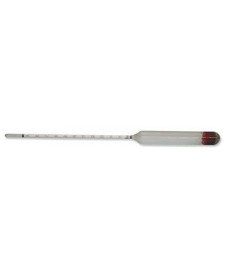
Glass hydrometer with Baumé scale for measuring liquid density or concentration
Accurate and easy-to-use instrument, calibrated at 20 °C for reliable readings in °Be.
Ideal for quality control in alcoholic beverages, syrups, saline solutions, or pharmaceutical products.
Available in various ranges, offering precision and user-friendly operation.
Perfect companion: 300 ml measuring cylinder with Ø 40 mm for accurate measurements.
Catalogue includes special Baumé models for syrups, lyes, musts, and saline solutions.
Glass hydrometer with Baumé scale for measuring liquid density or concentration
Accurate and easy-to-use instrument, calibrated at 20 °C for reliable readings in °Be.
Ideal for quality control in alcoholic beverages, syrups, saline solutions, or pharmaceutical products.
Available in various ranges, offering precision and user-friendly operation.
Perfect companion: 300 ml measuring cylinder with Ø 40 mm for accurate measurements.
Catalogue includes special Baumé models for syrups, lyes, musts, and saline solutions.
The Baumé hydrometer is an essential instrument for measuring the density or concentration of liquid solutions. Based on the principle of traditional hydrometers, it features a cylindrical shape similar to a thermometer, with a wider end acting as a floating base and the other end displaying the Baumé scale graduation (°Be).
The Baumé scale is calibrated with distilled water at 20 °C, meaning that a reading of distilled water at this temperature should indicate 0 °Be. Since liquid density varies with temperature, measurements must be taken at 20 °C or corrected using dedicated conversion tables when measured at other temperatures.
This type of hydrometer is widely used in industries such as alcoholic beverage production (beer, wine), honey and sugary product manufacturing, and in various chemical sectors. Its precision and ease of use make it a valuable tool for quality control processes.
The Baumé hydrometer enables the user to determine the concentration of a solution through direct readings on the scale, without the need for additional equipment. It is therefore suitable for both industrial and educational applications, particularly in teaching and studying physical and chemical principles such as density and concentration.
This measurement method is especially useful for quality control in the preparation of syrups, sugary beverages, saline solutions, or liquid pharmaceutical products. Choosing the appropriate range ensures a more accurate reading and facilitates work in industrial, educational or research environments.
To carry out these measurements correctly, it is essential to use suitable containers, such as cylinders, with the proper height and internal diameter for the measuring instrument (whether an alcoholmeter, hydrometer, mustimeter, or specialised liquid density meter). We offer a non-graduated glass cylinder specifically designed for such applications. With a capacity of 300 ml, an internal diameter of 40 mm and a total height of 300 mm, this cylinder provides optimal dimensions for precise laboratory measurements. It features a round base and smooth rim to ensure stability and ease of handling during use.
| Scale °Be | Divisions (°Be) |
Length | Reference |
|---|---|---|---|
| 0–50° | 1 | 240 mm | 406.050 |
| 0–70° | 1 | 290 mm | 406.070 |
| 5–15° | 0.10 | 310 mm | 406.515 |
| 0–10° | 0.10 | 310 mm | 406.010 |
| 10–20° | 0.10 | 310 mm | 406.1020 |
| 20–30° | 0.10 | 310 mm | 406.2030 |
| 30–40° | 0.10 | 310 mm | 406.3040 |
| 40–50° | 0.10 | 310 mm | 406.4050 |
| 50–60° | 0.10 | 310 mm | 406.5060 |
| 60–70° | 0.10 | 310 mm | 406.6070 |
Good morning:
In response to your enquiry, we need to know the Baumé scale of this chemical product. Once confirmed, we will be able to indicate the correct reference you should purchase together with the glass measuring cylinder, which is 524.017.
To use a hydrometer (aerometer for liquids) in a cylinder:
Grapes do not have "degrees" per se; what is measured is the sugar content in the must, which helps estimate probable alcohol content. We recommend two instruments:
Both options are reliable, but the refractometer is more practical and faster.