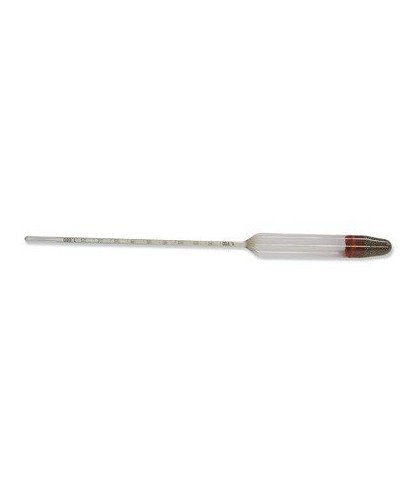
Transparent glass hydrometer calibrated at 20 °C for precise measurement of liquid density in kg/m³.
Overall length of 310 mm for comfortable immersion and reading across different sample volumes.
High-visibility graduated scale for fast, accurate readings that minimise errors.
Made from high-quality glass with excellent chemical resistance and durability against aggressive solutions.
Versatile use in laboratories (chemistry, biology), the food industry and quality control.
Available in multiple ranges: from 600–700 kg/m³ to 1,800–2,000 kg/m³, with 1/1 divisions.
Transparent glass hydrometer calibrated at 20 °C for precise measurement of liquid density in kg/m³.
Overall length of 310 mm for comfortable immersion and reading across different sample volumes.
High-visibility graduated scale for fast, accurate readings that minimise errors.
Made from high-quality glass with excellent chemical resistance and durability against aggressive solutions.
Versatile use in laboratories (chemistry, biology), the food industry and quality control.
Available in multiple ranges: from 600–700 kg/m³ to 1,800–2,000 kg/m³, with 1/1 divisions.
The hydrometer is a traditional instrument used to measure the density of liquids based on the principle of flotation: the higher the liquid’s density, the more the hydrometer floats; the lower the density, the deeper it sinks. The reading is taken directly from a scale expressed in kilograms per cubic metre (kg/m³), the standard unit of the International System.
This model is calibrated at 20 °C. Since density varies with temperature, it is essential to perform measurements at this temperature or apply corrections using standard conversion tables when working under different conditions.
This type of instrument is commonly used in the food, pharmaceutical, chemical and petrochemical industries, as well as in quality control laboratories and educational settings. Its intuitive design and direct reading make it a practical tool for verifying concentrations, validating liquid compositions or monitoring processes without the need for complex electronic equipment.
To ensure reliable measurements, it is essential to use suitable containers such as measuring cylinders that allow the hydrometer to float freely and vertically. The height and internal diameter of the container must match the size of the instrument. Our catalogue includes an ungraduated glass cylinder specifically designed for such applications, with a capacity of 300 ml, an internal diameter of 40 mm and a total height of 300 mm. This format ensures full immersion and clear readings. Its round base and smooth rim provide stability and ease of handling during the procedure.

Good morning:
In response to your enquiry, we need to know the Baumé scale of this chemical product. Once confirmed, we will be able to indicate the correct reference you should purchase together with the glass measuring cylinder, which is 524.017.
To use a hydrometer (aerometer for liquids) in a cylinder:
Grapes do not have "degrees" per se; what is measured is the sugar content in the must, which helps estimate probable alcohol content. We recommend two instruments:
Both options are reliable, but the refractometer is more practical and faster.