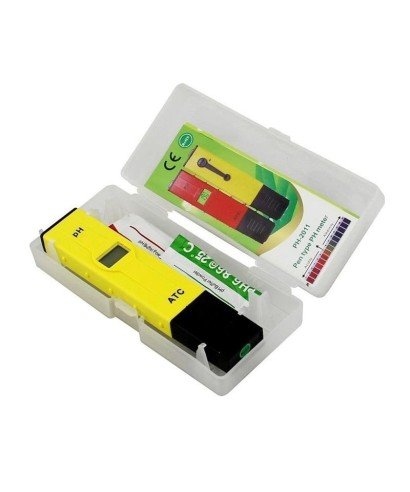
pH meter mini 9020, Scale pH 0-14
pH meter portable, lightweight, compact, and easy to handle
Ideal for measurements “in situ”, anywhere
Automatic temperature compensation between 5-50 °C
Manual calibration in 2 points
Accuracy ± 0.1 pH
Resolution 0.1 pH
Fixed electrode
Yellow colour.
For hygiene reasons, this product is non-returnable.
pH meter mini 9020, Scale pH 0-14
pH meter portable, lightweight, compact, and easy to handle
Ideal for measurements “in situ”, anywhere
Automatic temperature compensation between 5-50 °C
Manual calibration in 2 points
Accuracy ± 0.1 pH
Resolution 0.1 pH
Fixed electrode
Yellow colour.
For hygiene reasons, this product is non-returnable.
Compact, lightweight and easy-to-use pH meter, designed for quick on-site liquid measurements. Its portable format makes it ideal for fieldwork, mobile labs or applications outside standard laboratory environments.
Equipped with automatic temperature compensation for accurate and stable readings.
- Measurement range: pH 0–14
- Accuracy: ± 0.1 pH
- Resolution: 0.1 pH
- Calibration: manual, single-point
- Built-in fixed electrode
- Power supply: 2 × 1.5 V batteries (included)
Supplied with a calibration screwdriver and 2 buffer solution sachets for calibration.
Its compact size makes it ideal for regular pH level checks in laboratory, industrial or field settings, as well as in aquariums, pools, water treatment, aquaculture, agriculture, wastewater, and drinking water systems.
For hygiene reasons, this product is non-returnable once used. The electrode may become damaged and unusable for another customer. We recommend ensuring it meets your expectations before use. If you have any questions, we are at your service.
1. Preparing the Meter
- Electrode cleaning: Rinse the electrode with distilled water before each use to avoid cross-contamination.
- Calibration: Use standard buffer solutions (e.g. pH 4.01 and pH 7.01) to calibrate the device. Regular calibration is essential for accuracy.
2. Sample Preparation
- Light creams or gels: Can be measured directly by immersing the electrode into the sample.
- Thick creams or emulsions: Prepare a 10% dilution with distilled water. For example, mix 1 part cream with 9 parts water.
3. Measuring pH
- Electrode immersion: Submerge the electrode in the sample or prepared dilution.
- Stable reading: Wait until the value stabilises on the screen before recording.
4. pH Adjustment (if necessary)
- To increase pH (make more alkaline): Gradually add a diluted alkaline solution, such as sodium hydroxide, and mix thoroughly.
- To decrease pH (make more acidic): Gradually add a diluted acidic solution, such as citric acid, and mix thoroughly.
Additional Tips:
- Sample temperature: Ensure the sample is at room temperature (approx. 25 °C) for accurate readings.
- Electrode maintenance: After each use, rinse with distilled water and store as recommended by the manufacturer to extend its lifespan.
This information is for guidance purposes only and is non-binding.