- New
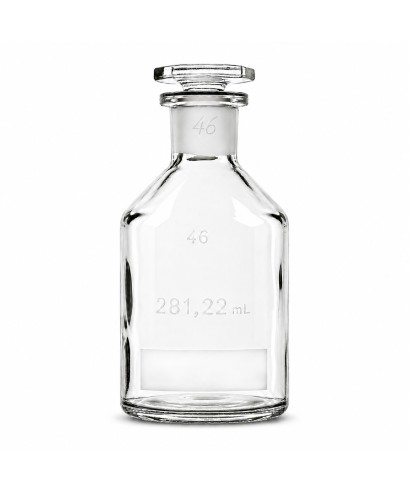
Winkler bottle in soda-lime glass for measuring dissolved oxygen in water samples, with a capacity of 250 - 300ml.
Each bottle has its exact volume engraved on it, used directly in the analysis calculation.
The ground-glass stopper seals without trapping air and carries the same number as its bottle.
A matt area allows sample details to be written on the bottle.
Dissolved oxygen is one of the basic indicators of water quality and is monitored in rivers, wastewater treatment plants, fish farms and environmental studies. The Winkler method, the reference chemical technique for measuring it, requires the sample to be kept out of contact with air, and the Winkler bottle is designed for this purpose.
To take the sample, the bottle is filled until it overflows, without air bubbles, and the stopper is inserted: its oblique cut pushes out the excess water without trapping air. The method reagents are then added and the sample is titrated to obtain the oxygen concentration.
The final calculation is based on the sample volume, so each bottle must always be used with the stopper bearing the same number: the engraved volume applies to that specific pair.
For BOD (biochemical oxygen demand) determination, two bottles are filled with the same sample: one is analysed immediately and the other after five days of incubation at 20 °C in the dark. The difference between the two results indicates the organic load of the water.
After each analysis, the bottle and its stopper should be washed together and stored with a strip of paper between the stopper and the neck to prevent the ground joint from seizing.
Reagents are not included.
