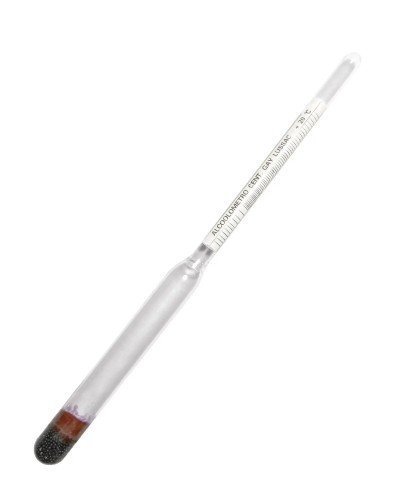
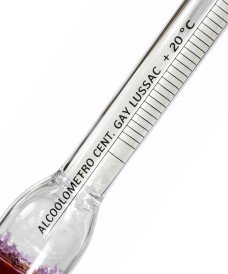
Glass alcoholmeter with Gay-Lussac scale: visual and direct measurement of alcohol content
Vertical-floating instrument that enables direct reading of the alcohol percentage by volume from the scale visible at the liquid level.
Available in various measurement ranges, suitable for both professional and domestic use.
Easy to use and calibrated at 20 °C for accurate readings.
Balanced design ensures stable vertical flotation for reliable readings without tilt or oscillation.
Requires the use of a measuring cylinder suitable for its length to ensure accurate results.
Ideal for oenology, distillation, quality control, and educational purposes.
Glass alcoholmeter with Gay-Lussac scale: visual and direct measurement of alcohol content
Vertical-floating instrument that enables direct reading of the alcohol percentage by volume from the scale visible at the liquid level.
Available in various measurement ranges, suitable for both professional and domestic use.
Easy to use and calibrated at 20 °C for accurate readings.
Balanced design ensures stable vertical flotation for reliable readings without tilt or oscillation.
Requires the use of a measuring cylinder suitable for its length to ensure accurate results.
Ideal for oenology, distillation, quality control, and educational purposes.
The graduated glass alcoholmeter is a simple and reliable instrument used to determine the alcohol content by volume in hydroalcoholic solutions, such as wines, spirits, distilled beverages, or technical preparations. It operates on the flotation principle: the instrument remains upright thanks to the balance between the weight of the ballast and the air volume enclosed within its body. As the ethanol concentration increases, the liquid becomes less dense, causing the device to sink further.
This type of meter features the Gay-Lussac scale, which allows for a direct reading of the ethanol percentage, from 0% (pure water) to 100% (absolute alcohol), without the need for additional calculations. The reading is taken at the point where the surface of the liquid intersects with the scale on the stem. It is essential that the sample is clean, still, and free of bubbles to ensure an accurate measurement.
Temperature plays a key role in obtaining reliable results. It is calibrated for use at 20 °C. If used at a different temperature, correction must be applied using standard tables, especially in settings requiring traceability or strict quality control.
This type of instrument is commonly used in distilleries, oenology laboratories, the food industry, and educational environments, providing a practical solution for determining alcohol strength without relying on digital technology or complex procedures.
To ensure an accurate reading, it is essential to use a suitable container that allows the instrument to be positioned fully upright. Typically, glass cylinders with appropriate internal height and diameter are used. In our catalogue, we offer a specific model: a 300 ml ungraduated glass cylinder, specially designed for this type of application. It has an internal diameter of 40 mm and a total height of 300 mm. These dimensions ensure proper immersion and clear readings. It also features a rounded base and smooth rim for greater stability and ease of handling during the measurement process.
| Gay-Lussac Scale | Divisions | Length | Reference |
|---|---|---|---|
| 0–100 % | 1 % | 290 mm | 404.0100 |
| 0–100 % | 1 % | 200 mm | 404.0100-P |
| 0–10 % | 0.1 % | 330 mm | 404.010 |
| 10–20 % | 0.1 % | 330 mm | 404.1020 |
| 20–30 % | 0.1 % | 380 mm | 404.2030 |
| 30–40 % | 0.1 % | 315 mm | 404.3040 |
| 40–50 % | 0.1 % | 315 mm | 404.4050 |
| 50–60 % | 0.1 % | 315 mm | 404.5060 |
| 60–70 % | 0.1 % | 380 mm | 404.6070 |
| 70–80 % | 0.1 % | 380 mm | 404.7080 |
| 80–90 % | 0.1 % | 380 mm | 404.8090 |
| 90–100 % | 0.1 % | 380 mm | 404.90100 |

Good morning:
In response to your enquiry, we need to know the Baumé scale of this chemical product. Once confirmed, we will be able to indicate the correct reference you should purchase together with the glass measuring cylinder, which is 524.017.
To use a hydrometer (aerometer for liquids) in a cylinder:
Grapes do not have "degrees" per se; what is measured is the sugar content in the must, which helps estimate probable alcohol content. We recommend two instruments:
Both options are reliable, but the refractometer is more practical and faster.