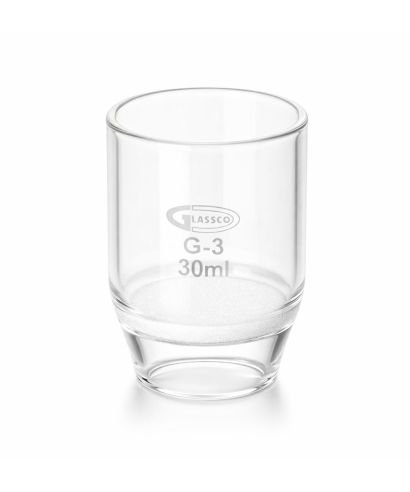
The glass filtering crucible, available in various capacities, is essential in laboratories. Made from borosilicate glass 3.3, it complies with DIN 12348 and ASTM E 438 standards. It offers excellent chemical resistance and can be used in ovens up to 500 °C with gradual heating.
The glass filtering crucible, available in various capacities, is essential in laboratories. Made from borosilicate glass 3.3, it complies with DIN 12348 and ASTM E 438 standards. It offers excellent chemical resistance and can be used in ovens up to 500 °C with gradual heating.
The glass filtering crucible is an essential laboratory tool made of borosilicate glass 3.3, in compliance with DIN 12348. This material is known for its low thermal expansion, meeting the ASTM E 438, TYPE 1, CLASS A standard.
Thermal Resistance: Although borosilicate glass offers good thermal resistance, it should not be exposed to extremely high temperatures or direct flames. It can be safely used in a drying oven up to 500 °C, provided that heating is gradual.
Usage Recommendations:
| Pore Grade | Porosity |
|---|---|
| G0 | 160–250 µm |
| G1 | 90–150 µm |
| G2 | 40–90 µm |
| G3 | 15–40 µm |
| G4 | 5–15 µm |
Properties of Borosilicate Glass 3.3:
This type of glass is distinguished by its excellent chemical resistance to water, saline solutions, acids, and bases. However, it is sensitive to hydrofluoric acid and may be attacked by strong bases or phosphoric acid at high temperatures.