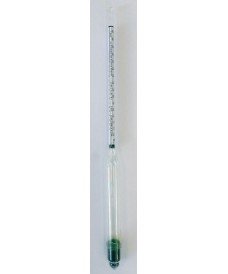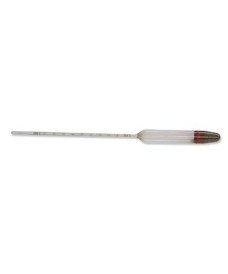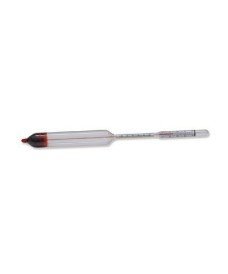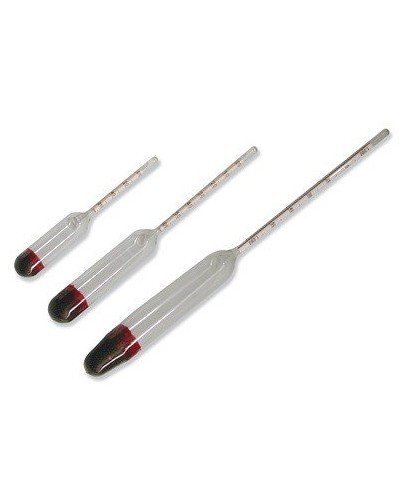
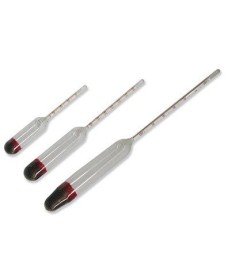
Jolles-type urinometer, calibrated at 20 °C with a range of 1,000–1,060 kg/m³ with 1-unit divisions
Compact and reliable instrument for clinical analysis, designed to measure the specific gravity of urine accurately.
Made of glass, with a total length of 145 mm.
Jolles-type urinometer, calibrated at 20 °C with a range of 1,000–1,060 kg/m³ with 1-unit divisions
Compact and reliable instrument for clinical analysis, designed to measure the specific gravity of urine accurately.
Made of glass, with a total length of 145 mm.
The urine hydrometer, also known as a urinometer, is an instrument used to measure the relative density or specific gravity of urine. This measurement is essential in clinical laboratories to assess the kidney’s ability to concentrate and dilute urine, and to detect potential imbalances in the body’s hydration status.
The standard model features a scale from 1,000 to 1,060 kg/m³ with 1-unit divisions, calibrated at 20 °C. It is made of glass and has a total length of 145 mm. Its simple, reagent-free use makes it a practical choice for routine analysis.
The hydrometer operates on the principle of flotation: the instrument is placed vertically into a cylinder containing a sufficient volume of liquid sample. The depth of immersion varies depending on the density of the liquid, and the reading is taken at the point where the liquid surface intersects the scale on the stem. For reliable results, the sample must be bubble-free and at a stable temperature. If the temperature differs from 20 °C, the appropriate correction must be applied using standard compensation tables. Our catalogue includes ungraduated glass cylinders specifically designed for use with hydrometers, alcoholmeters, and aerometers.
In addition to traditional hydrometers, alternative methods exist for measuring urine density. Among them, refractometers allow readings using just a single drop of sample, based on the liquid’s refractive index. Our catalogue includes a handheld clinical refractometer with automatic temperature compensation (ATC), reference 720.3120, specifically designed for medical applications. This model features three integrated scales: serum proteins, urine specific gravity, and refractive index. A versatile and precise tool for healthcare professionals and diagnostic laboratories.
| Model | Range | Graduation | Length | Reference |
|---|---|---|---|---|
| Jolles urinometer | 1.000–1.060 kg/m³ | 1 kg/m³ | 145 mm | 407.001 |

Good morning:
In response to your enquiry, we need to know the Baumé scale of this chemical product. Once confirmed, we will be able to indicate the correct reference you should purchase together with the glass measuring cylinder, which is 524.017.
To use a hydrometer (aerometer for liquids) in a cylinder:
Grapes do not have "degrees" per se; what is measured is the sugar content in the must, which helps estimate probable alcohol content. We recommend two instruments:
Both options are reliable, but the refractometer is more practical and faster.