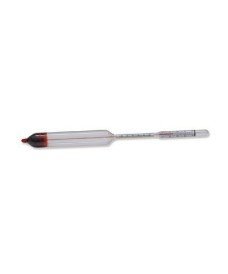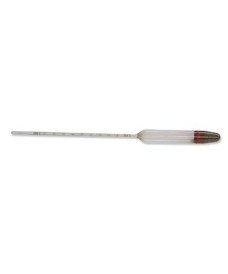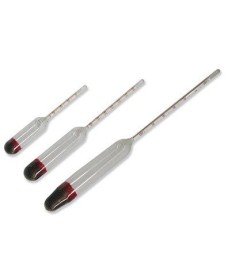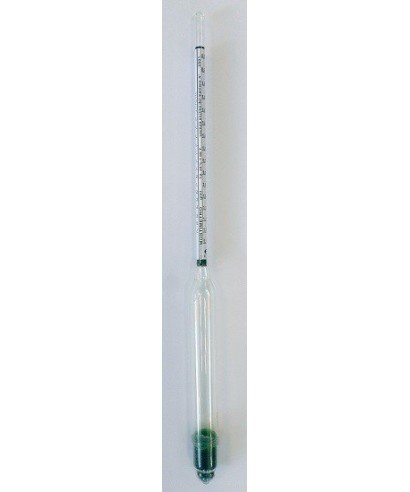
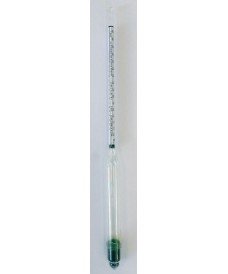
Must hydrometers with double and triple scale, depending on the model: Baumé degrees (°Bé), density (kg/m³) and probable alcohol content.
Calibrated at 20 °C, they are designed to offer accurate measurements and easy handling during the production of wines and craft beers.
The durable glass body features clearly defined colour markings, allowing quick readings and reducing the margin of error.
Suitable for both hobbyists and professionals in the wine and brewing sectors, they stand out for their reliability, user-friendly design and consistent results.
They are supplied with a protective plastic case for safe storage and transport.
Must hydrometers with double and triple scale, depending on the model: Baumé degrees (°Bé), density (kg/m³) and probable alcohol content.
Calibrated at 20 °C, they are designed to offer accurate measurements and easy handling during the production of wines and craft beers.
The durable glass body features clearly defined colour markings, allowing quick readings and reducing the margin of error.
Suitable for both hobbyists and professionals in the wine and brewing sectors, they stand out for their reliability, user-friendly design and consistent results.
They are supplied with a protective plastic case for safe storage and transport.
Must hydrometers are glass instruments used to measure the sugar concentration in fermentable liquids such as grape, barley or apple must. This analysis is essential for monitoring fermentation and estimating the final alcohol content during the production of wine, beer or cider.
We offer dual and triple scale models that allow direct readings without additional calculations. The scales combine Baumé degrees (°Bé), density (kg/m³), and probable alcohol content (% v/v), making it easier to monitor the fermentation process in technical, artisanal or educational settings.
All models are calibrated at 20 °C, ensuring reliable results under standard conditions. If measurements are taken at a different temperature, the appropriate correction should be applied using specific tables. A difference of just a few degrees can significantly affect the final reading, so it is essential to keep the sample at the correct temperature. The liquid must be still, clean, and free of bubbles to obtain an accurate reading.
The operating principle is based on flotation: the higher the sugar concentration, the higher the must density and the less the hydrometer sinks. The reading is taken at the point where the liquid intersects the visible scale on the stem.
Available models:
These instruments are made of durable glass, designed for repeated use in laboratories, wineries, microbreweries, home brewing, training centres, quality control facilities or educational workshops.
The glass body features coloured markings to enhance visibility during reading. Their simple operation and clear scale make them a practical and reliable tool for all types of users, from technical personnel to independent producers and students.
All models come with an individual plastic case that protects the instrument when not in use, ensuring long-term durability.
For safe and accurate measurements, it is recommended to use an ungraduated glass cylinder suited to the instrument’s dimensions. We offer a specific model with a 300 ml capacity, 40 mm internal diameter and 300 mm total height. This cylinder ensures stability thanks to its round base and smooth rim, allowing vertical immersion of the hydrometer and undistorted readings.
You may also be interested in other complementary measuring instruments from our catalogue, such as alcoholmeters, liquid balances and hydrometers in various scales depending on the analysis required. For dedicated must measurement, we also offer special single-scale models such as the Baumé hydrometer (ref. 410.013).
| Model | Range and graduations | Length | Reference |
|---|---|---|---|
| 2 scales: Baumé + probable alcohol | 0–20° Baumé (0.2°) 4–22 % probable alcohol (0.2 %) |
260 mm | 414. |
| 2 scales: Density + probable alcohol | 980–1130 kg/m³ (1) 4–18 % probable alcohol (0.5 %) |
310 mm | 414-D |
| 3 scales: Density + Baumé + probable alcohol | 980–1130 kg/m³ (0.1) 0–16° Baumé (0.5°) 3–17 % probable alcohol (0.5 %) |
290 mm | 414.003 |
Also check other complementary measurement solutions available in our catalogue, such as alcoholmeters, liquid density testers, and hydrometers with various scales depending on the type of analysis required. For exclusive must measurement, we offer special models such as the Baumé hydrometer with a single scale (ref. 410.013).
We also offer handheld refractometers designed for specific applications:
| Model | Range and graduations | Length | Reference |
|---|---|---|---|
| 1 scale: Baumé | 0–30° Baumé (0.5°) | 290 mm | 410.013 |

Good morning:
In response to your enquiry, we need to know the Baumé scale of this chemical product. Once confirmed, we will be able to indicate the correct reference you should purchase together with the glass measuring cylinder, which is 524.017.
To use a hydrometer (aerometer for liquids) in a cylinder:
Grapes do not have "degrees" per se; what is measured is the sugar content in the must, which helps estimate probable alcohol content. We recommend two instruments:
Both options are reliable, but the refractometer is more practical and faster.