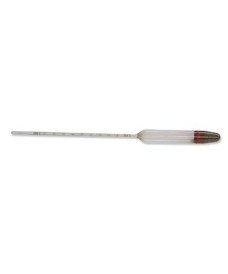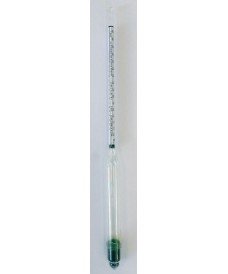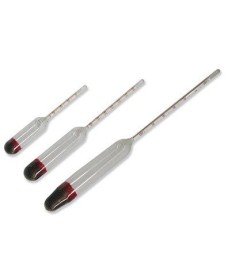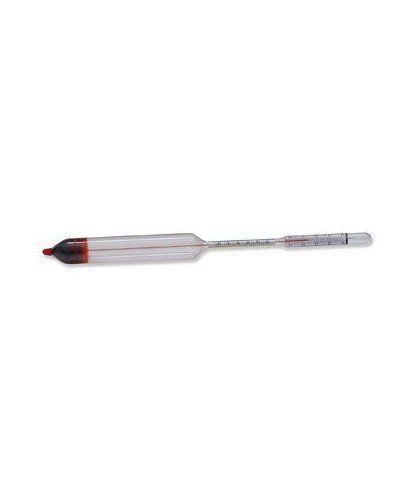
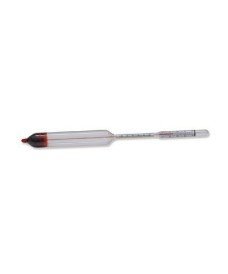
Quevenne glass lactodensimeters for accurate milk density measurement.
An essential instrument for measuring milk density, ensuring its purity and quality.
With a range of 15 to 40 units (equivalent to 1.015–1.040 kg/m³), this device offers precision in dairy analysis.
Two models available: standard scale and version with thermometer (0–40 °C).
Calibrated at 20 °C for consistent results.
Ideal for detecting adulteration and assessing the composition of dairy products.
Quevenne glass lactodensimeters for accurate milk density measurement.
An essential instrument for measuring milk density, ensuring its purity and quality.
With a range of 15 to 40 units (equivalent to 1.015–1.040 kg/m³), this device offers precision in dairy analysis.
Two models available: standard scale and version with thermometer (0–40 °C).
Calibrated at 20 °C for consistent results.
Ideal for detecting adulteration and assessing the composition of dairy products.
These are glass instruments specifically designed to measure the density of milk, an essential parameter for assessing its quality and detecting possible adulterations such as water dilution or fat removal. This measurement provides direct information about the product’s purity and composition and is widely used in laboratory analysis, quality control in the dairy industry and agri-food activities.
The operating principle of the lactodensimeter is based on flotation: the instrument is carefully placed vertically into a cylinder containing a sufficient quantity of liquid sample. The denser the liquid, the less the instrument sinks. The reading is taken at the exact point where the surface of the liquid intersects the graduated scale on the stem. For reliable results, the sample must be bubble-free, still, and at a controlled temperature. If the sample temperature differs from the calibration temperature (20 °C), appropriate corrections should be made using reference tables.
We offer two models based on the Quevenne scale, which ranges from 15 to 40 units, corresponding to densities between 1.015 and 1.040 kg/m³. Each unit represents one thousandth above 1.000 kg/m³. For example, a reading of 34 corresponds to a density of 1.034 kg/m³. This scale is particularly suitable for full-fat milk, which typically ranges from 1.028 to 1.034 kg/m³.
The standard model, with a length of 215 mm, offers a simple and effective solution for direct density measurement. For greater accuracy, the model with built-in thermometer, 290 mm long, includes a temperature scale from 0 to 40 °C (1 °C resolution), allowing temperature monitoring during measurement.
Both instruments are made of durable glass and calibrated at 20 °C. We recommend using an ungraduated glass cylinder, matched to the instrument’s length, to ensure an accurate reading without optical interference. Our catalogue includes various cylinder models specifically designed for this type of analysis.
They are essential tools in any setting where strict milk quality control is required, from small producers to specialised laboratories.
Note: Products are delivered without instructions for use.
| Model | Range | Graduation | Length | Reference |
|---|---|---|---|---|
| Quevenne 15–40 | 1,015 to 1,040 kg/m³ | 1 | 215 mm | 412.002 |
| Quevenne 15–40 with thermometer |
1,015 to 1,040 kg/m³ 0–40 °C |
1 1 °C |
290 mm | 412.003 |
Note: density is expressed in thousandths above unity.

Good morning:
In response to your enquiry, we need to know the Baumé scale of this chemical product. Once confirmed, we will be able to indicate the correct reference you should purchase together with the glass measuring cylinder, which is 524.017.
To use a hydrometer (aerometer for liquids) in a cylinder:
Grapes do not have "degrees" per se; what is measured is the sugar content in the must, which helps estimate probable alcohol content. We recommend two instruments:
Both options are reliable, but the refractometer is more practical and faster.