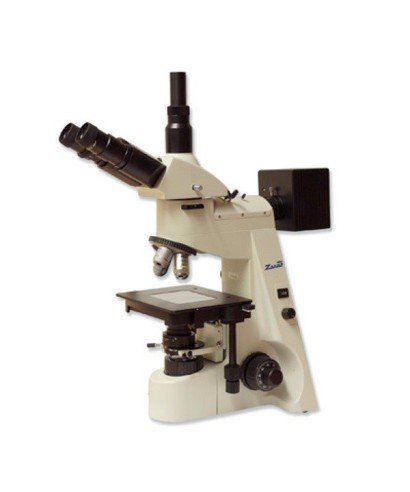

Zuzi 146MET Polarising Metallurgical Microscope designed with infinity-corrected optics, it enables polarised light observation, ideal for applications in petrography, mineralogy, materials chemistry, histology, and pathological anatomy. It allows analysis of birefringent structures such as crystals, pigments, fluids, and amyloid deposits.
Trinocular head with a third tube for USB camera connection, fixed dovetail mount, and manual rotation via locking screw.
Eyepieces: 2 × WF 10×/22 mm and 1 × WF 10×/20 mm with 0–16 scale. Dioptric adjustment on the left eyepiece.
Quintuple nosepiece for fast objective exchange.
Focusing: coaxial coarse and fine adjustment knobs.
Condenser: Abbe type N.A. 1.25, with filter holder and adjustable diaphragm.
Mechanical stage: 180 × 150 mm, with smooth and precise movement.
Objectives: L PLAN 5×/0.12 (WD: 23.6 mm), 10×/0.25 (WD: 17.7 mm), 20×/0.40 (WD: 10.4 mm), 50×/0.55 (WD: 7.0 mm).
Zuzi 146MET Polarising Metallurgical Microscope designed with infinity-corrected optics, it enables polarised light observation, ideal for applications in petrography, mineralogy, materials chemistry, histology, and pathological anatomy. It allows analysis of birefringent structures such as crystals, pigments, fluids, and amyloid deposits.
Trinocular head with a third tube for USB camera connection, fixed dovetail mount, and manual rotation via locking screw.
Eyepieces: 2 × WF 10×/22 mm and 1 × WF 10×/20 mm with 0–16 scale. Dioptric adjustment on the left eyepiece.
Quintuple nosepiece for fast objective exchange.
Focusing: coaxial coarse and fine adjustment knobs.
Condenser: Abbe type N.A. 1.25, with filter holder and adjustable diaphragm.
Mechanical stage: 180 × 150 mm, with smooth and precise movement.
Objectives: L PLAN 5×/0.12 (WD: 23.6 mm), 10×/0.25 (WD: 17.7 mm), 20×/0.40 (WD: 10.4 mm), 50×/0.55 (WD: 7.0 mm).
The Zuzi Model 146 is a professional polarising metallurgical microscope, designed for observations under polarised light. Its infinity-corrected optics, combined with a robust and stable mechanical system, make it an essential tool for applications in petrography, mineralogy, metallurgy, materials science, histology and pathological anatomy.
The polarisation system includes a polarising filter (north-south axis) located below the stage and an analyser (east-west axis) above it. When both filters are positioned orthogonally (90°), light is extinguished, resulting in a dark background. If the sample exhibits birefringence, relevant structures appear bright against this background, allowing clear observation of crystals, pigments, anisotropic liquids or amyloid deposits.
The microscope features infinity-corrected optics and a Köhler illumination system with field and aperture diaphragms, adjustable Abbe condenser (NA 1.25), pre-condenser and fine intensity control via a 30 W halogen lamp. This setup ensures uniform, distortion-free illumination with high contrast.
It includes a 360° rotatable polariser, a rotating analyser with Vernier scale (90°), and a slidable Bertrand lens for conoscopic observation. There is also a slot for compensator plates: gypsum, mica and quartz wedge, all positioned at 45° to the principal vibration axes.
The 160 mm circular stage rotates 360° with 0.1° graduation, features a locking mechanism, and allows for the addition of a mechanical stage for precise sample movement. Fixed clips ensure secure sample placement.
The Siedentopf-type trinocular head is inclined at 30°, with interpupillary distance adjustment (55–75 mm) and dioptre correction on the left eyepiece holder. Compatible with Zuzi ocular cameras. The coaxial coarse and fine focusing knobs are ergonomically positioned: the right one with friction control, the left with a locking lever to protect the sample.
The episcopic (reflected) illumination system includes a 12 V / 30 W halogen lamp, centreable diaphragms, a rotating filter holder (green, blue, yellow, polariser) and full control of the incident light. The diascopic (transmitted) illumination system uses a second halogen lamp of the same type, with a height-adjustable Abbe condenser, movable filter holder, and precision diaphragms.
The Model 146 is designed for demanding analyses in metallography, microcircuit observation, crystalline materials, anisotropic liquids, thin films, PCB and more. Its T-shaped architecture ensures maximum stability without compromising ergonomics, making it a versatile solution for quality control labs, teaching and technical analysis.
| Head | Trinocular: inclined, 30°, and rotatable, 360°. Rod for light beam control. Compatible with eyepiece cameras. |
| Interpupillary distance | 55–75 mm |
| Optical correction | ±5 dioptres on right eyepiece holder |
| Eyepieces | WF 10× / 22 mm and WF 20 mm with 0.1 mm reticle |
| Stage | Double-layer mechanical stage, 160 × 180 mm |
| Nosepiece | Quadruple |
| Objectives | Plan achromatic metallurgical: 4× (N.A. 0.10); W.D.: 25 mm 10× (N.A. 0.25); W.D.: 11 mm 20× (N.A. 0.40); W.D.: 8 mm 40× (N.A. 0.65); W.D.: 3.8 mm |
| Illumination | Reflected (episcopic) and transmitted (diascopic). Köhler system. |
| Reflected illumination | Lamp: Halogen 12 V 30 W. Field and aperture diaphragms (centrable). Filter holder: Rotating with green, blue, yellow and polarised filters. |
| Transmitted illumination | Lamp: Halogen 12 V 30 W. Diaphragms: Field in pre-condenser and graduated aperture. Filters: Movable, green, blue and yellow. |
| Polarisation system | Polariser in filter holder and sliding analyser in the optical path, 360° rotatable. |
| Condenser | Abbe (N.A. 1.25), height adjustable. |
| Power supply | 100-240 V AC 50-60HZ |
